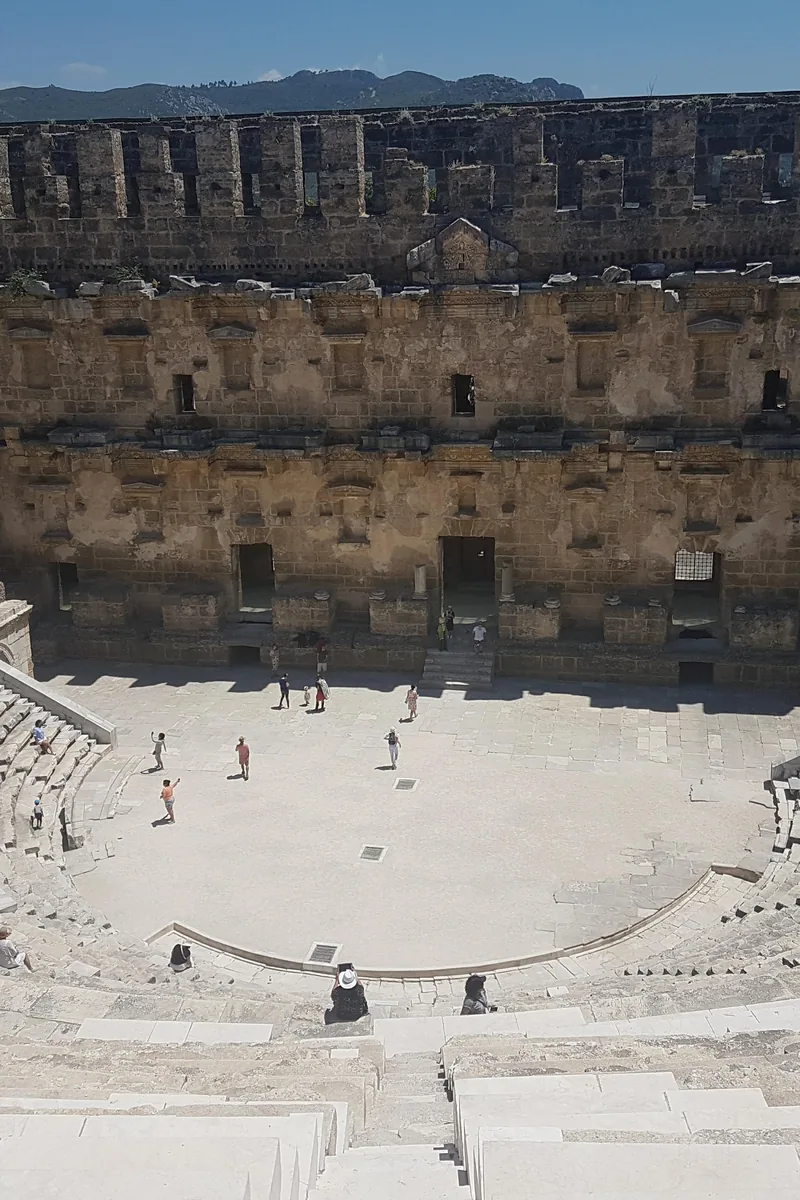
Aspendos stands on the Eurymedon river near Serik, about 40 km east of Antalya on Türkiye's Mediterranean coast. It was a wealthy Greco-Roman city, and its theatre — built in the 2nd century AD by Zenon, a Greek architect native to the city — is the reason travellers come from across the region. Where most ancient theatres survive only as tiers of seating, Aspendos keeps its full stage building standing to its original height, so you enter a Roman theatre almost as its audience once did rather than reading its outline from the stones.
The theatre is famous for its acoustics: the semicircle of stone seating and the tall stage wall were engineered so that a voice from the stage carries clearly to the highest row, and the building still hosts live performances, including the annual Aspendos International Opera and Ballet Festival held here each summer. Its remarkable state of preservation owes much to the Seljuk period, when the structure was repaired and reused as a caravanserai and palace rather than quarried for stone.
Aspendos is more than its theatre. Spread across a lower and an upper city are the remains of a Roman aqueduct that carried water for kilometres on tall arches, a 100-metre basilica, the agora, a monumental fountain and the acropolis — the civic heart of a city that grew rich on trade. The site is on Türkiye's UNESCO World Heritage Tentative List. The standard ticket is open-dated: you choose your day, arrive during opening hours, and walk straight in.